01
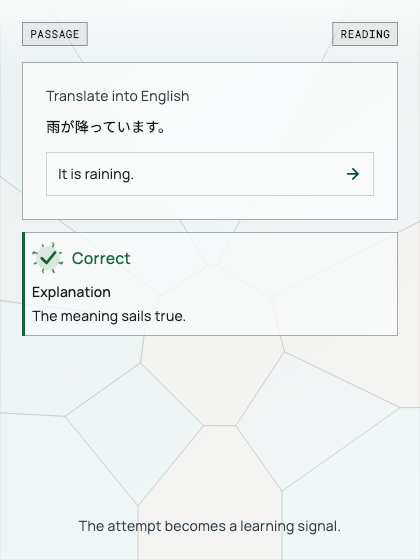
Correct, drawn in ink.
When a resolved grade is correct, an accent splash and a drawn check mark the result once.
 Shaded
Choose your route
Page language: English. Learning: Japanese.
Japanese · Spanish · English
Real sentences, feedback tied to the exact word or pattern you missed, and a next lesson built from it.
Not a deck · Not a fixed course · Not an open-ended chatbot
Your route, drawn. Solid ports are already yours. Switch the traveler.
Why it feels different
It breaks every sentence into the pieces you actually learn. Then three moves, on repeat:
A sentence breaks into its real units. Each unit is known three ways — and dealt as practice in every format your skills need.
In Japanese, grammar rides on particles — は and を become pieces of their own.
When coverage is available, checked against a real dictionary or source — not an AI's hunch.
anchors · provenance食べる, 食べます, 食べた are one unit to learn — not three cards.
the lexemeReading a word isn't saying it. Tracked across reading, writing, listening, speaking.
per-skill depthIn Spanish, the verb form carries who is acting — the subject pronoun can often disappear.
When coverage is available, checked against a real dictionary or source — not an AI's hunch.
anchors · provenancecomer, como, comí, comeré are one unit to learn — not four cards.
the lexemeReading a word isn't saying it. Tracked across reading, writing, listening, speaking.
per-skill depth英語では、文法は語順と語形に表れます。
対応する出典がある場合は、実在する辞書や資料と照合します。
アンカー・出典eat, eats, ate, eaten はすべて一つの語。別々のカードではありません。
語彙素(レキシム)読めても話せるとは限りません。読む・書く・聞く・話すを個別に記録します。
技能別の深さスペイン語では、動詞の形に「誰がするか」という情報が含まれます。
対応する出典がある場合は、実在する辞書や資料と照合します。
アンカー・出典comer, como, comí, comeré はすべて一つの語。別々のカードではありません。
語彙素(レキシム)読めても話せるとは限りません。読む・書く・聞く・話すを個別に記録します。
技能別の深さEn inglés, la gramática vive en el orden de las palabras y en sus terminaciones.
Cuando hay cobertura, se contrasta con un diccionario o una fuente real.
anclas · procedenciaeat, eats, ate, eaten son una sola unidad, no cuatro tarjetas.
el lexemaLeer una palabra no es decirla. Se sigue en lectura, escritura, escucha y habla.
profundidad por destrezaEn japonés, la gramática viaja en partículas: は y を se convierten en piezas propias.
Cuando hay cobertura, se contrasta con un diccionario o una fuente real.
anclas · procedencia食べる, 食べます, 食べた son una sola unidad, no tres tarjetas.
el lexemaLeer una palabra no es decirla. Se sigue en lectura, escritura, escucha y habla.
profundidad por destrezaSix forms one unit can take. Which one appears is not a rotation — the weakest skill and what is due decide.
食べます means —
Say “I eat bread” in Japanese
私はパンを
Catch the verb — …パンを__ます
Say it out loud — graded on what it hears
Six forms one unit can take. Which one appears is not a rotation — the weakest skill and what is due decide.
como means —
Say “I eat bread” in Spanish
Yo pan
Catch the verb — “Yo ___ pan”
Say it out loud — graded on what it hears
一つの語がとる6つの形。どれが出るかはローテーションではなく、いちばん浅い技能と復習期限で決まります。
eat の意味は —
「私はパンを食べる」を英語で
I bread
動詞を聞き取る — “I __ bread”
声に出して — 聞こえたとおりに採点します
一つの語がとる6つの形。どれが出るかはローテーションではなく、いちばん浅い技能と復習期限で決まります。
como の意味は —
「私はパンを食べる」をスペイン語で
Yo pan
動詞を聞き取る — “Yo __ pan”
声に出して — 聞こえたとおりに採点します
Seis formas que puede tomar una unidad. Cuál aparece no es una rotación: lo deciden la destreza más floja y lo que toca repasar.
eat significa —
Di «Yo como pan» en inglés
I bread
Atrapa el verbo — “I ___ bread”
Dilo en voz alta: se evalúa lo que se oye
Seis formas que puede tomar una unidad. Cuál aparece no es una rotación: lo deciden la destreza más floja y lo que toca repasar.
食べます significa —
Di «Yo como pan» en japonés
私はパンを
Atrapa el verbo — …パンを__ます
Dilo en voz alta: se evalúa lo que se oye
Not right-or-wrong on the whole line — every unit in your answer gets its own verdict, so the one piece that broke is named.
One particle broke — を, the object marker, swapped for は. That single piece is what comes back for practice, not the whole sentence again.
One form broke — comer conjugated for the wrong person. The conjugation is what comes back for practice, not the whole sentence.
壊れたのは冠詞ひとつ。bread は不可算名詞 — 次の練習は文全体ではなく、この一点に絞られます。
壊れたのは活用ひとつ — comer の一人称 como。次に練習するのは文全体ではなく、この一点です。
Falló un artículo, nada más. bread es incontable — y esa única pieza es la que vuelve a practicarse, no la frase entera.
Falló una partícula: を, el marcador de objeto, sustituido por は. Esa pieza — no la frase entera — es lo que se practica después.
New material arrives as one new unit carried by units you already own. Strong concepts become the context that makes the next one learnable.
朝 is the only new thing in the frame. Everything else you own — so the new word lands inside a sentence you can already read.
One new chunk, carried by three units you own — new language embedded in language you can already read.
新しいのは in the morning だけ。残りはすべて既知 — 新しい表現が、すでに読める文の中に届きます。
新しいのは por la mañana だけ。強くなった概念が、次の一つを支える文脈になります。
Lo único nuevo es in the morning. El resto ya es tuyo — lo nuevo aterriza en una frase que ya sabes leer.
Lo único nuevo es 朝 (mañana). Todo lo demás ya es tuyo — la palabra nueva llega dentro de una frase que ya lees.
Every format above asks your memory for the unit — recognition at the shallow end, full production at the deep end — instead of re-showing it. Retrieval practice — the testing effect — is one of the most replicated results in learning science, and Shaded credits deeper retrieval more.
retrieval practiceEvery unit is scheduled on its own forgetting curve with a modern spaced-repetition model (FSRS), per skill. It comes back when it is about to fade — not when a deck rotation says so.
spaced repetition · FSRSA whole-sentence “wrong” teaches almost nothing. A verdict on the exact particle or form is corrective feedback — the kind that converts errors into learning.
error-specific feedbackn+1 is comprehensible input: new language embedded in language you already parse. Hard enough to stretch, known enough to read.
comprehensible inputFlashcard apps grade the card. Fixed courses grade the quiz. Shaded grades the piece — and over years, that difference compounds.
Built for the messy middle
For the stretch between knowing a rule and using it naturally. One learner, one route, four beats.
A real sentence, graded honestly. Wrong is not the end of the story; it is the start of the route.
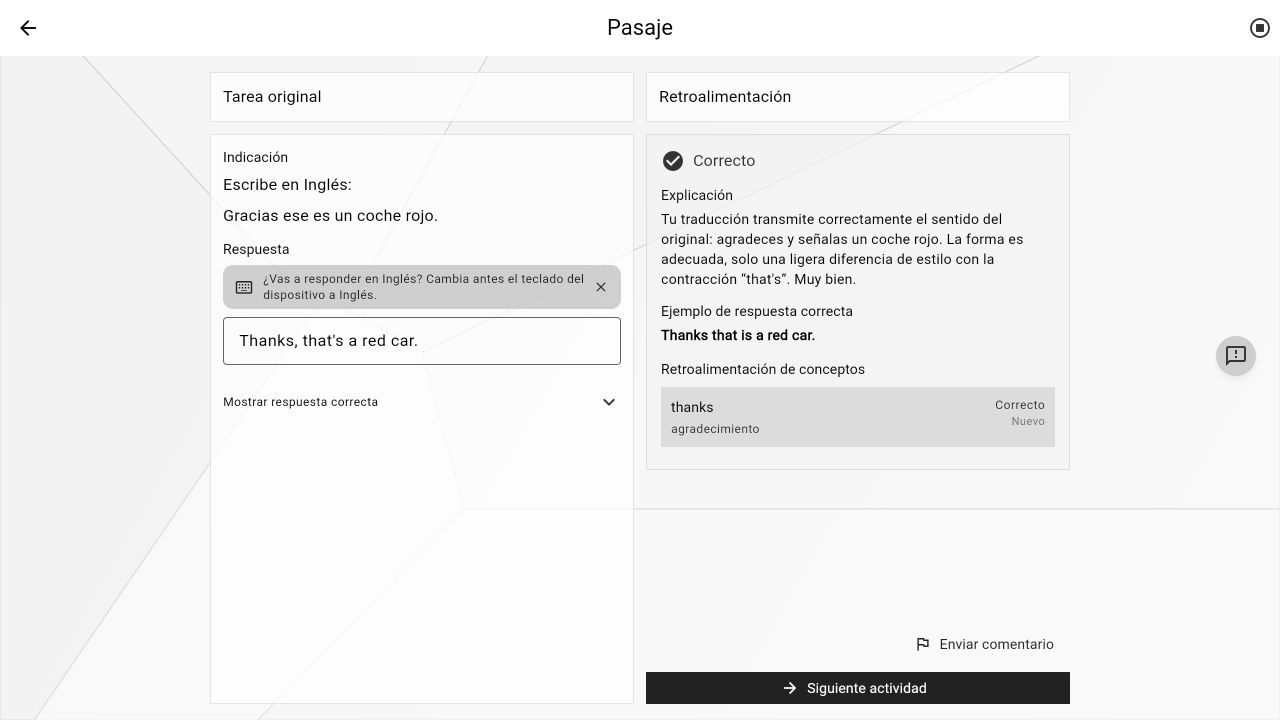
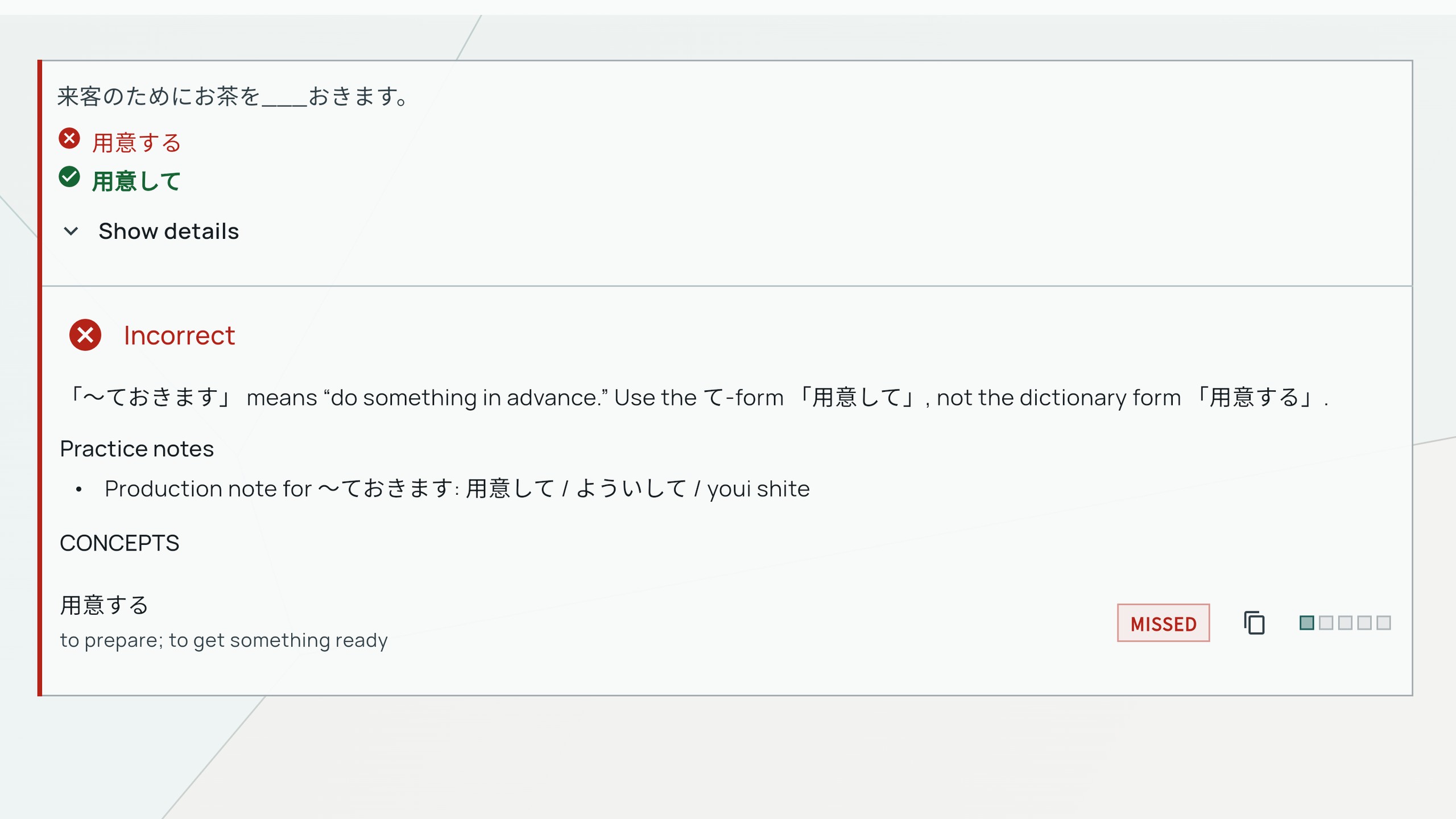
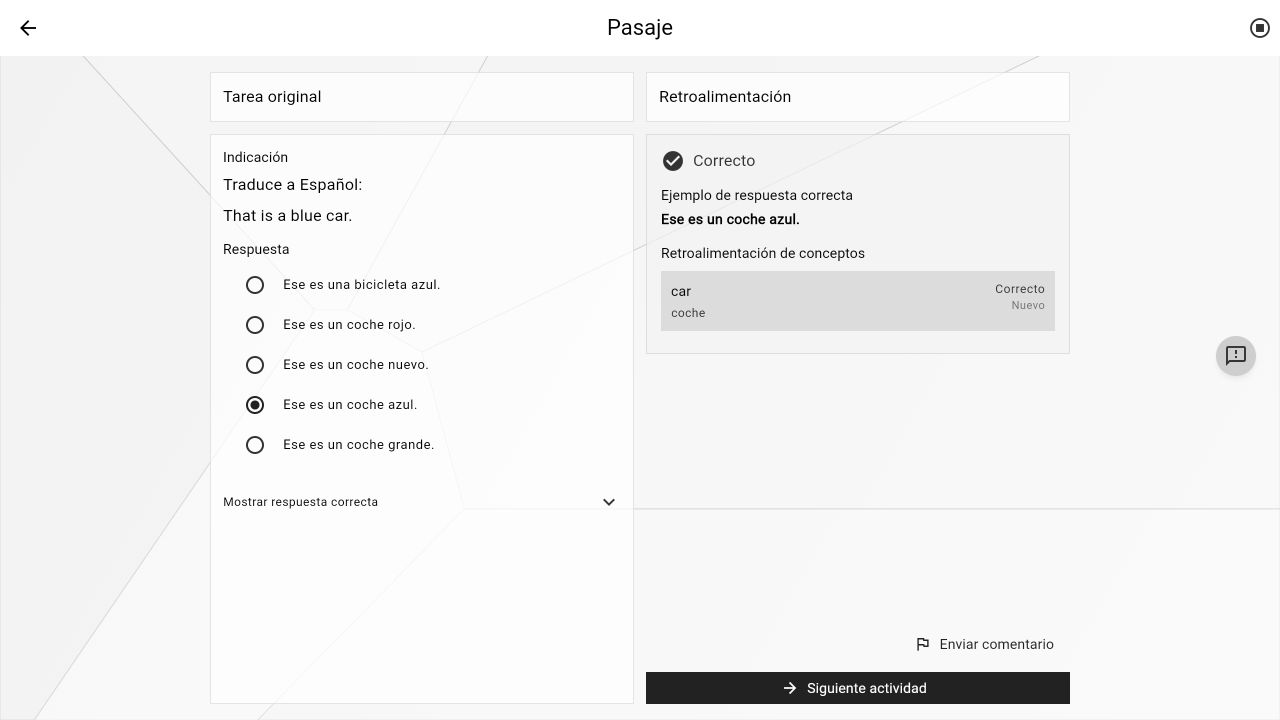
Not the whole exercise — the exact word, particle, or pattern, tracked by the skill it lives under.
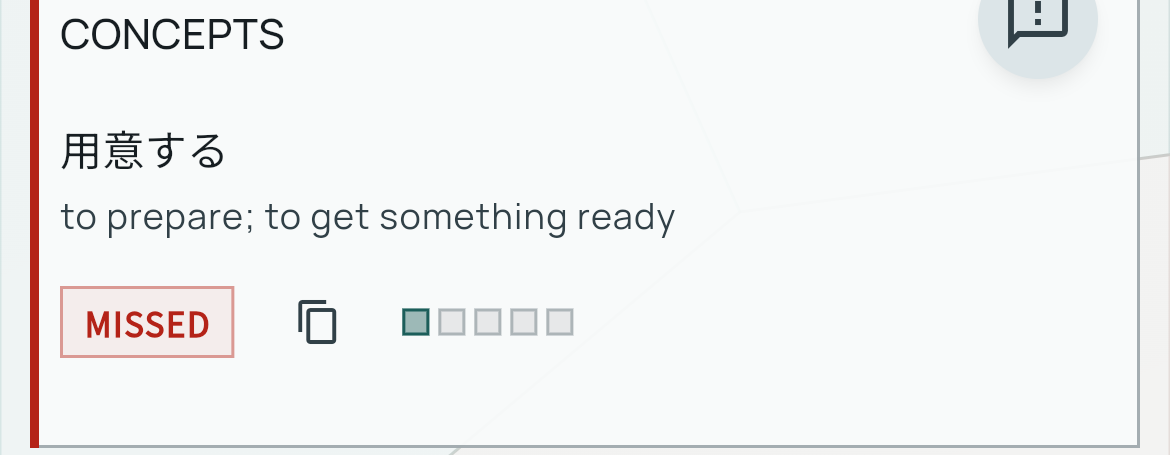
That miss, what is due, and your level become the next practice. No queue to tune, no starting over.
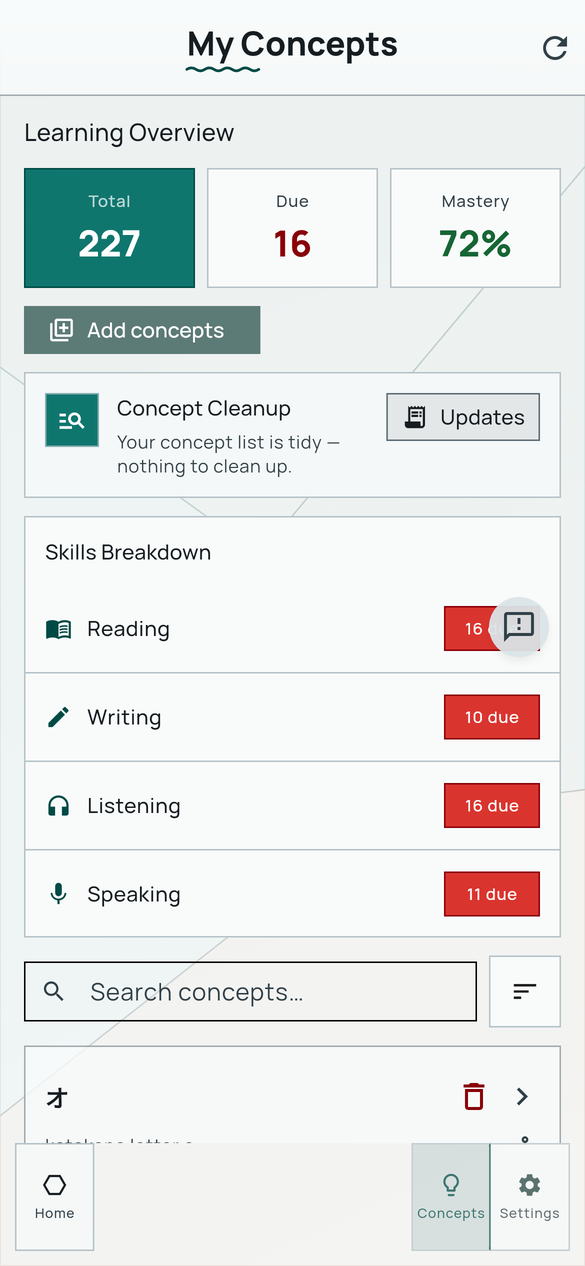
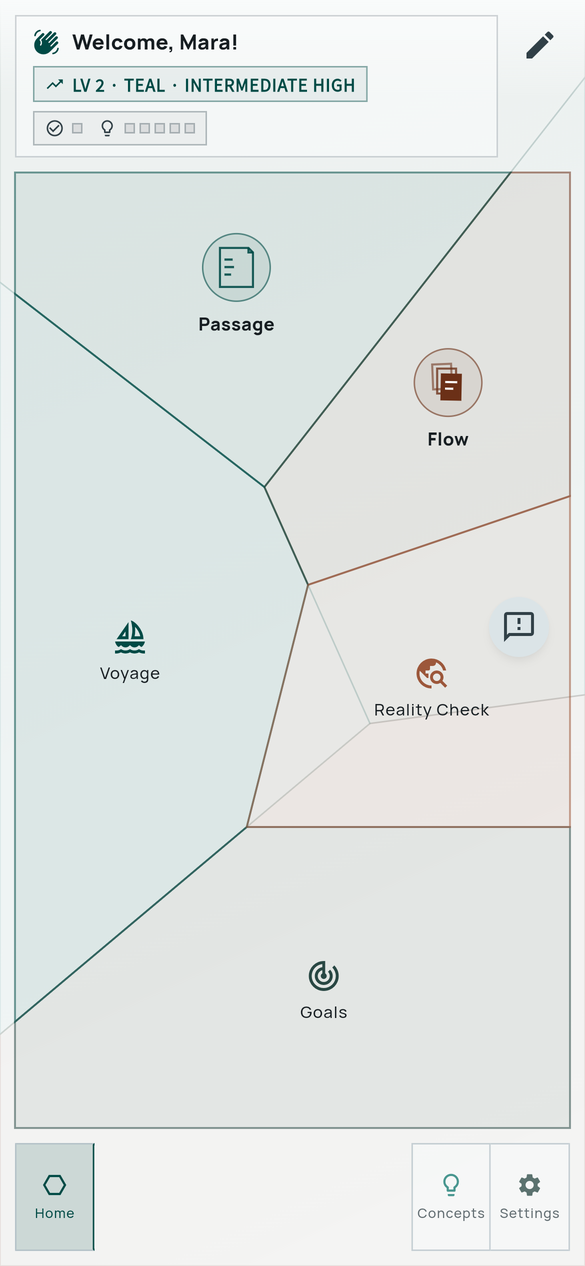
The receipt stays attached to the sentence: dictionaries, sourced examples, reviewed material — flexible where it helps, inspectable where it counts.
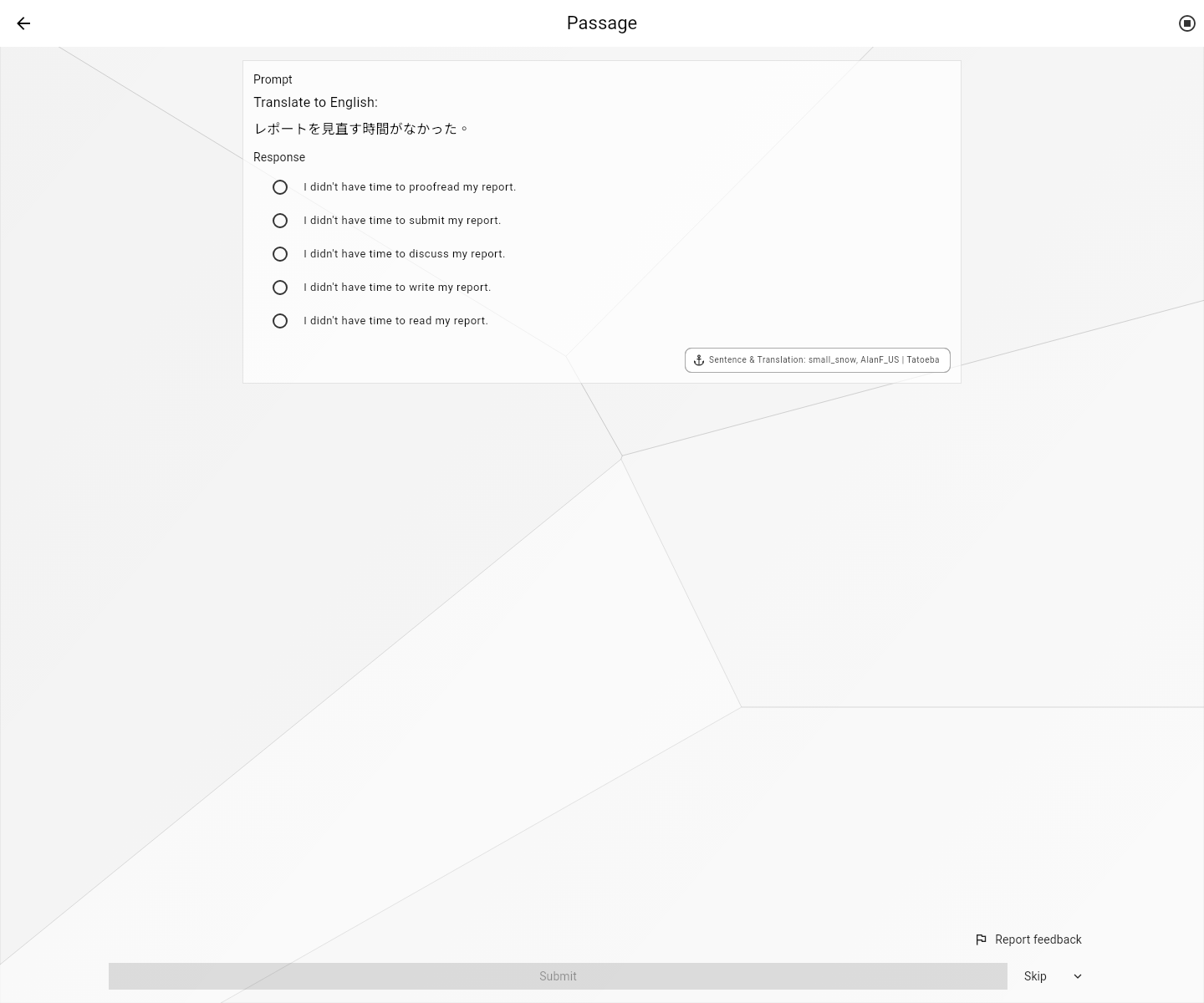
Now on the web
The screen changes. The learner model—and the work that is due—comes with you.
Open Shaded on webInkField in motion
Designed in ink. Revealed in color. Motion is reserved for a learner action or an earned change.
When a resolved grade is correct, an accent splash and a drawn check mark the result once.
When a new theme tier is earned, pigment travels cell by cell before the stable accent changes.

Voyage · earned play
Complete today’s goal and Voyage can surface a fishing reward. The learning engine still comes from your answers; Voyage makes the momentum tangible.

Built for the messy middle
The value is not that Shaded generates more practice. It is that Shaded keeps learning from what happens when you try to use the language.